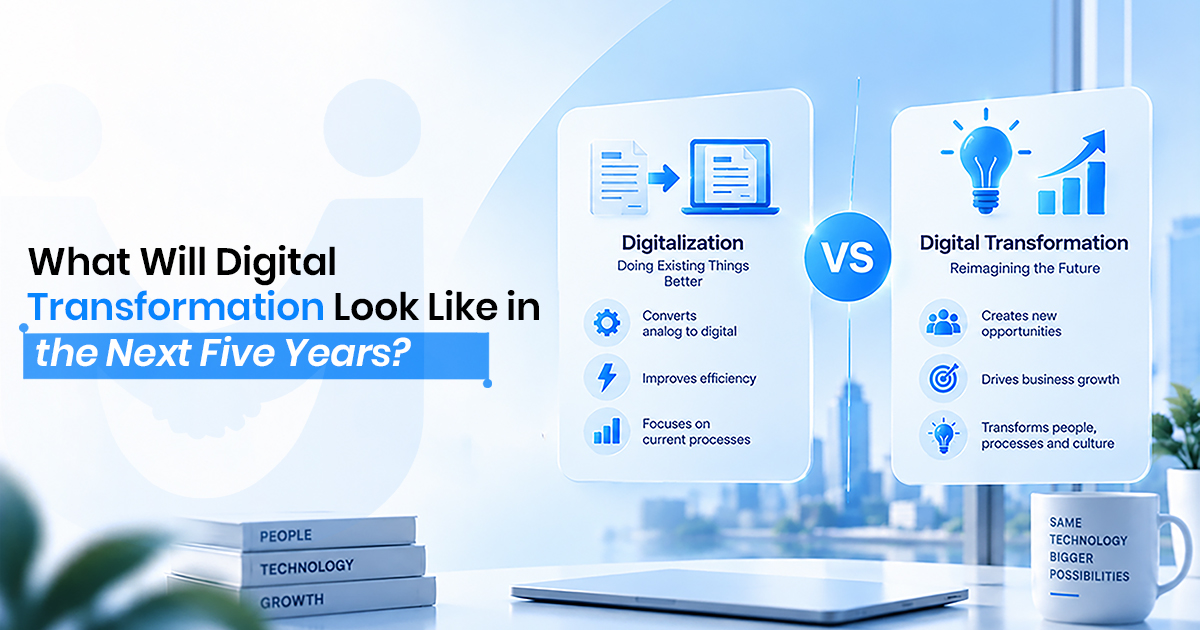
Digital transformation has moved beyond simply adopting new software or technology or shifting business processes online. Using new technology to improve decision making, automate operations, giving personalised experience to customers, and building more adaptable business models is something which businesses are experimenting with. As technology will continue to evolve, the future of digital transformation will be shaped by how effectively businesses are combining emerging technologies with their people, processes and organisational goals.
In the next 5 years, digital transformation is expected to become smarter and more connected in the daily routine of business operations. Below are some of the key developments that will shape the future of digital transformation.
1. Intelligent Automation Will Become Standard
Automation will continue to move beyond repetitive administrative tasks. Businesses will increasingly use intelligent systems to analyze information, identify patterns, support decisions, and manage complex workflows.
Organizations will focus on automating complete processes rather than individual tasks. For example, instead of automating only data entry, businesses may connect multiple steps such as information collection, validation, processing, reporting, and notifications.
This shift will make automation an important part of operational strategy and contribute to greater efficiency and consistency.
2. Data Will Drive More Business Decisions
Data has already become an important business asset, but its role will become even more significant when major decisions in organisations are dependent on data. Organizations will increasingly expect real-time and accurate insights rather than relying solely on historical reports.
Advanced analytics, and intelligent data platforms will help businesses identify trends, understand customer behavior, monitor performance, and anticipate potential challenges. As data becomes more accessible across departments, decision-making will become increasingly evidence-based.
The ability to turn large volumes of information into actionable insights will be a major differentiator in the future of digital transformation.
3. Cloud Technology Will Become More Flexible
Cloud computing will continue to form the foundation of modern digital infrastructure. However, businesses will increasingly focus on flexible cloud environments that allow them to integrate different applications, platforms, and data sources.
Hybrid and multi-cloud approaches may become more common as organizations balance scalability, performance, cost, security, and regulatory requirements.
This will allow businesses to build technology environments that can adapt as their operational needs change.
4. Cybersecurity Will Become Part of Transformation Strategy
As businesses become increasingly dependent on connected digital systems, cybersecurity will become a core component of digital transformation rather than an afterthought.
Organizations will invest in stronger identity management, data protection, threat monitoring, and security frameworks. Employees will also play an important role as businesses strengthen security awareness and establish responsible technology practices.
Future transformation strategies will therefore need to consider both innovation and resilience.
5. Customer Experiences Will Become More Personalized
Customers are the key part of any business and expect businesses to understand their requirements and expectations. They expect seamless experience across all digital channels. Businesses who have already won this have succeeded and continue to scale. This has encouraged organisations to use customer data and technology to create more personalized interactions with their customers.
Businesses may use predictive analytics, intelligent recommendations, automated communication, and connected customer platforms to deliver relevant experiences at different stages of the customer journey.
Personalization will become less about individual marketing campaigns and more about creating consistently connected experiences.
6. Emerging Technologies Will Work Together
One of the most important digital transformation trends will be the convergence of multiple technologies. Instead of adopting emerging technologies independently, organizations will increasingly combine cloud computing, advanced analytics, automation, connected devices, and other technologies to solve specific business challenges.
This convergence will create new opportunities for digital innovation and allow businesses to develop solutions that were previously difficult or expensive to implement.
7. Digital Transformation Will Become More Human-Centric
Technology may be at the center of transformation, but people will remain critical to its success. Organizations will increasingly focus on employee experience, digital skills, collaboration, and change management.
Employees will need to understand how new technologies affect their roles and how they can use digital tools effectively. Businesses that invest in training and create a culture of continuous learning will be better positioned to adapt to changing technologies.
Preparing for the Next Five Years
The future technology trends are shaping the digital transformation while creating significant opportunities. Businesses need to understand that simply adopting a new technology just because it is new in the market should not be an objective. Successful transformation happens when businesses identify and understand the challenges and act upon it. A wise selection of technology makes all the difference.
Organizations should build flexible technology strategies, strengthen their digital infrastructure, develop employee capabilities, and continuously evaluate customer and operational needs. Keeping up with business technology trends will also help organizations identify opportunities before they become mainstream.
The Future Is Continuous Transformation
The next five years will not represent a final stage of digital transformation. Instead, transformation will become an ongoing process of adaptation and improvement. New technologies will continue to emerge, while existing technologies will become more integrated into everyday business operations.
The organizations most likely to succeed will be those that view digital transformation as a long-term business strategy rather than a one-time technology project. By combining emerging technologies with strong leadership, skilled employees, reliable data, and customer-focused thinking, businesses can turn digital innovation into sustainable growth.
Ultimately, the digital transformation future will be defined not simply by how much technology businesses adopt, but by how effectively they use it to create meaningful, measurable, and lasting value.