Healthcare organizations generate, maintain and exchange vast amounts of information on a daily basis. Patient information, lab reports, prescriptions, insurance data, billing and documents move from one department to another. This flow information if not communicated properly may result in delays, and access to fragmentated information may cause difficulty in access.
This is when healthcare interoperability becomes essential. Enabling different healthcare systems and applications to exchange and use information effectively, interoperability can help create a more connected, efficient, and patient-focused healthcare environment.
What Is Healthcare Interoperability?
Healthcare interoperability is defined as an ability of different healthcare systems, applications, and devices to securely exchange, interpret, and use health information.
For example, a hospital information system may need to share patient information with a laboratory system, pharmacy platform, or another healthcare provider. Without interoperability, the staff may have to manually enter or transfer information between systems, increasing the possibility of errors and delays.
Here healthcare data interoperability will help this information move between systems in a structured and meaningful way, without any loss of data or miscommunication. It will help healthcare professionals access relevant information when they need it.
Breaking Down Information Silos
One of the biggest healthcare challenges in information silos. Different departments use their respective software to manage their data which makes it difficult for the other departments to access the same. These systems may work well for the particular department but creates challenges when information needs to be shared.
Hospital interoperability helps connect these systems and software, hence allowing relevant information to move across departments and workflows. Instead of maintaining isolated sources of information, hospitals can create a more unified and centralised digital environment.
This can improve coordination between registration, clinical departments, laboratories, radiology, pharmacy, billing, and administration.
Improving Healthcare Information Exchange
Effective healthcare information exchange allows authorized healthcare professionals and organizations to share relevant patient information more efficiently.
Consider a patient who visits a hospital after receiving diagnostic tests at another healthcare facility. If the systems are interoperable, relevant reports and medical information can potentially be exchanged electronically, subject to appropriate authorization and privacy requirements.
This reduces dependence on paper documents and manual information transfer while giving healthcare professionals better access to the patient's available medical history.
Supporting Better Patient Care
Access to accurate and timely information can directly influence healthcare delivery. Doctors and clinicians need relevant medical histories, prescriptions, test results, medication information, and previous treatment details to make informed decisions at the right time to avoid delays in the treatment and other formalities.
Interoperable healthcare systems provide a more complete view of patient information across different points of care. This will help in reducing repetitive data collection, support better patient care and will provide a better patient experience. Also, it will support better coordination between healthcare officials.
For patients, this can mean a smoother experience, fewer repeated procedures, and less need to provide the same information multiple times.
Enhancing Operational Efficiency
Interoperability can also improve administrative and operational efficiency. When systems are connected, information can move automatically between relevant workflows instead of requiring employees to repeatedly enter the same data.
For example, information captured during patient registration can potentially flow into other authorized systems and processes. Similarly, laboratory results can be made available to relevant clinical workflows without requiring manual transfer.
This form of healthcare integration can reduce repetitive work, minimize data-entry errors, and allow employees to focus on higher-value activities.
Strengthening Data-Driven Decision-Making
Healthcare organisations get access to broader and more consistent data sets with connected systems. This helps in reporting, data analytics, resource planning, and decision making in operational processes.
Hospital administrators can use this information to understand patient volumes, hospital footfall, performance of departments, resource utilization and other operations. With time, this will help organisations identify inefficiencies, gaps and make more informed decisions.
However, interoperability is not simply about connecting systems. Data must also be standardized and interpreted consistently for information to be useful across different platforms.
Building a Connected Healthcare Ecosystem
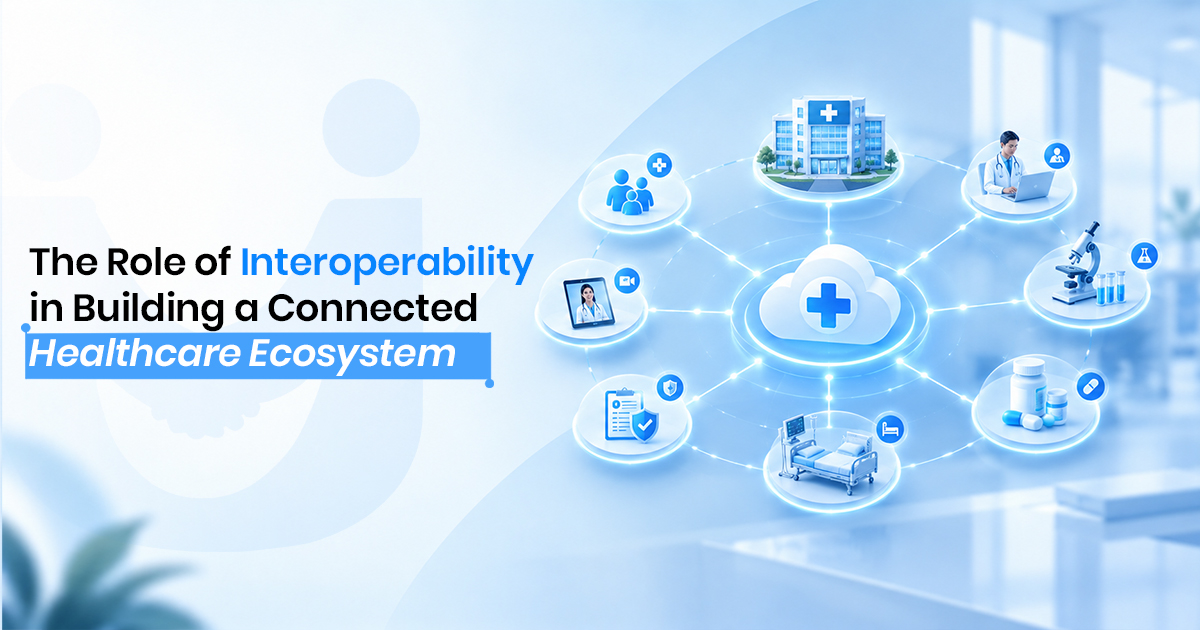
A smart connected healthcare ecosystem extends beyond a single hospital. It can include hospitals, clinics, labs, pharmacies, insurance providing companies and other healthcare stakeholders. When these participants can exchange relevant information securely, healthcare systems become more connected in the patient journey. This can support continuity of patient care and reduce information silos between different healthcare touchpoints.
Achieving this level of connectivity requires more than technology. Organizations need common data standards, appropriate security controls, governance policies, and clearly defined processes for information exchange.
Challenges to Healthcare Interoperability
Despite its benefits, interoperability can be difficult to implement. Healthcare organizations often use legacy systems, different data formats, and applications from multiple vendors. Concerns around privacy, cybersecurity, regulatory requirements, and data ownership can also complicate information exchange.
Organizations therefore need a structured approach to healthcare integration. Technology platforms should be selected based on their ability to communicate with existing systems while maintaining security, scalability, and data quality.
The Future of Connected Healthcare
As healthcare continues to adopt digital technologies, interoperability will become increasingly important. Artificial intelligence, machine learning, analytics, remote monitoring, digital health platforms, and other innovations depend on access to reliable and connected data.
The goal is not simply to make healthcare systems communicate better but to create an ecosystem where information is secure.
And finally, healthcare interoperability provides the foundation for a more connected healthcare ecosystem. By working on information silos, one can improve healthcare information exchange, support operational efficiency and enable better access to patient information. This will help businesses deliver more coordinated, connected and efficient healthcare.