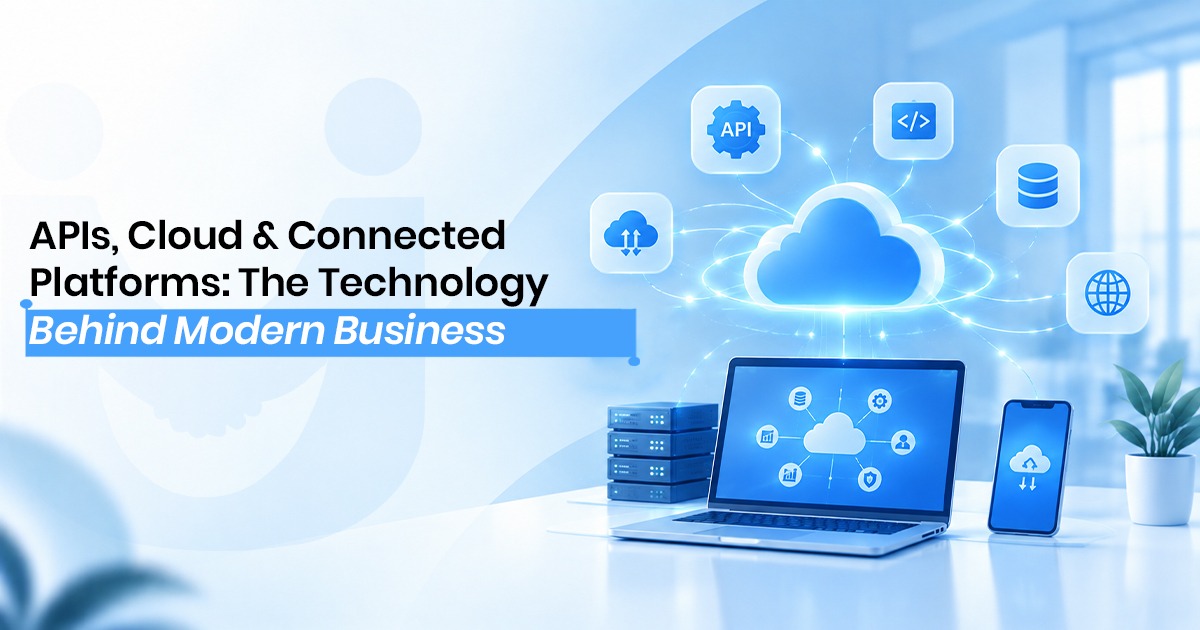
Modern businesses rarely operate through a single technology platform. Customer management, finance, communication, analytics, operations, and internal workflows may all rely on different applications and services.
The challenge is making these technologies work together.
This is where connected platforms, APIs, and cloud technology are becoming fundamental to modern business infrastructure. Instead of operating as isolated tools, businesses can connect their systems, share information, and build digital ecosystems that are more flexible and responsive.
Why Connected Platforms Matter
A connected business doesn't mean that it uses many platforms but simply relies on a single tool that can communicate and work together effectively.
It has been observed that when a system operates independently, employees may not have full access to the information. There are chances that they might need to refer to many systems and tools to get the right and the full information. This can create duplication, delays, inconsistent data, and fragmented workflows.
Platform integration helps address this challenge by connecting different applications and services so information can move more efficiently between them.
For businesses, this can mean smoother processes, better visibility, and less dependency on manual work.
The Role of APIs in Business
APIs means Application Programming Interfaces that connect digital experiences.
APIs in business allow different software applications to communicate with each other. They provide a structured and organised way for one system to request or share information with another without requiring the two platforms to be built in the same way.
For example, a business application may use an API to connect with a payment service, customer database, analytics platform, or communication tool.
This makes it possible for organisations to build technology environments where different solutions can work together while continuing to serve their specific purposes.
API Integration and Business Flexibility
Nevertheless, API integration makes businesses more adaptable.
Companies should think of replacing their current technology with new capabilities and technology environments wherever needed. They need not to change the entire ecosystem. Businesses just need to identify the areas that need transformation.
This modular approach allows businesses to adopt new technologies more strategically. It can also make it easier to expand digital capabilities as business requirements change.
The goal is not to connect everything simply because it can be connected. Effective integration should solve a specific operational challenge or create meaningful business value.
Cloud Technology as Digital Infrastructure
The growth of cloud technology has further changed how businesses build and manage their digital infrastructure.
Cloud-based platforms can provide organisations with access to computing resources, applications, storage, and services without requiring every capability to be maintained within traditional on-premise environments.
More importantly, cloud environments can support collaboration, scalability, and integration across distributed teams and systems.
As businesses increasingly operate across locations, devices, and digital channels, flexible infrastructure becomes an important part of maintaining continuity and accessibility.
Connecting the Cloud
Where multiple cloud-based applications are becoming a part of businesses on daily based operations, businesses also need to consider how these platforms should communicate.
Cloud integration lets different cloud services and applications exchange information and data and support shared workflows.
For example, the data generated at one cloud application can potentially be made available to another system through APIs or integration platforms. This can help organisations create a more unified technology environment instead of managing multiple disconnected applications.
Building a Stronger Digital Infrastructure
This wise combination of APIs, cloud services, and connected platforms is creating a new approach to digital infrastructure.
Rather than viewing technology as a collection of separate applications, businesses can begin thinking of it as an interconnected ecosystem.
This approach can support faster information flow, more streamlined operations, and greater flexibility as organisations evolve.
However, successful integration requires more than technology. Businesses need to understand their processes, data requirements, security considerations, and long-term objectives before building their integration strategy.
At IUI Solutions, we believe modern digital transformation is about creating technology ecosystems that work together with purpose. By connecting platforms, processes, and information, organisations can create a stronger foundation for growth and innovation.
The future of business technology will not be defined by individual systems working in isolation.
It will be defined by how effectively those systems connect, communicate, and work together. Connected technology creates connected possibilities.